

Main Content
The contribution of collaborative workspaces in rural areas
New open-access anthology published
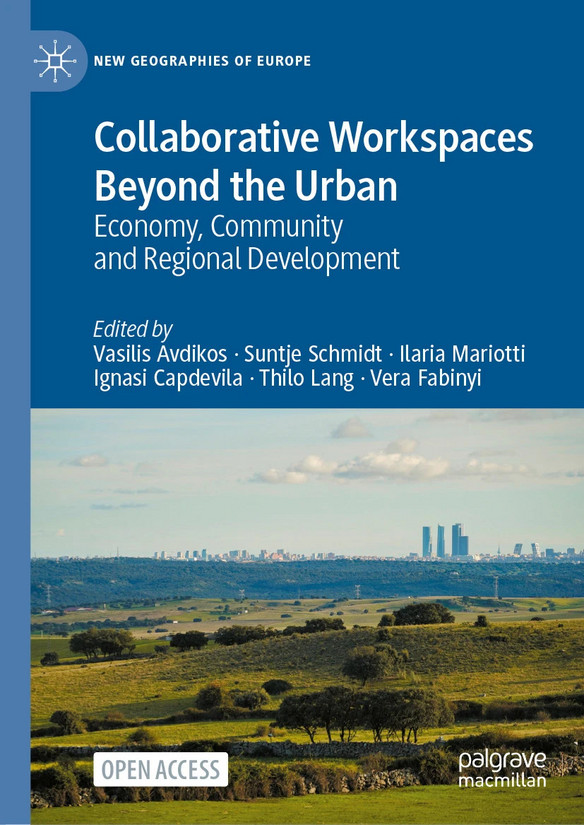
Coworking spaces have arrived in rural areas. However, this phenomenon of new workspaces, originally emerged in major cities, has not simply spread geographically, but has evolved in many ways. A recently published anthology explores this development.
Together with Vasilis Avdikos, Ilaria Mariotti, Ignasi Capdevila, Thilo Lang and Vera Fabinyi, project partners from the EU project 'CORAL', Suntje Schmidt has contributed to the publication of the anthology 'Collaborative Workspaces Beyond the Urban'. The book examines the development processes and impacts of rural collaborative workspaces (CWS), such as maker spaces or fab labs. The contributions shed light on CWS in rural, suburban and peripheral areas, analysing their economic, social and community effects at local and regional levels, as well as for individual workers and the enterprise. The book brings together contributions from a wide range of academic disciplines, including social and economic geography, economics, business studies, architecture, spatial planning, gender studies and management research.
Since 2021, the EU-funded Marie Skłodowska-Curie Innovative Training Network (ITN) ‘CORAL’ has been researching the unique role of collaborative workspaces in rural regions of Europe and their significance for regional development. As part of the network, 15 PhD students have gained academic and practical qualifications over the past few years to actively shape this still-emerging field in the future: in planning, regional development or politics, in initiatives, cooperatives or businesses. These included Federica Ammaturo (Associate) and Chen Gao (Alumnus), who conducted research at the IRS under the supervision of Suntje Schmidt.