

Main Content
Compact, mixed, well-connected
Call for Papers for Special Issue in Raumforschung und Raumordnung | Spatial Research and Planning (RuR)
Compact, mixed-use neighbourhoods with short distances and good links to public transport – that's the promise of Transit-Oriented Development. In Germany, however, the concept has so far rarely been applied to the redevelopment of existing built-up areas. A Special Issue of the journal "Raumforschung und Raumordnung" seeks to close this gap.
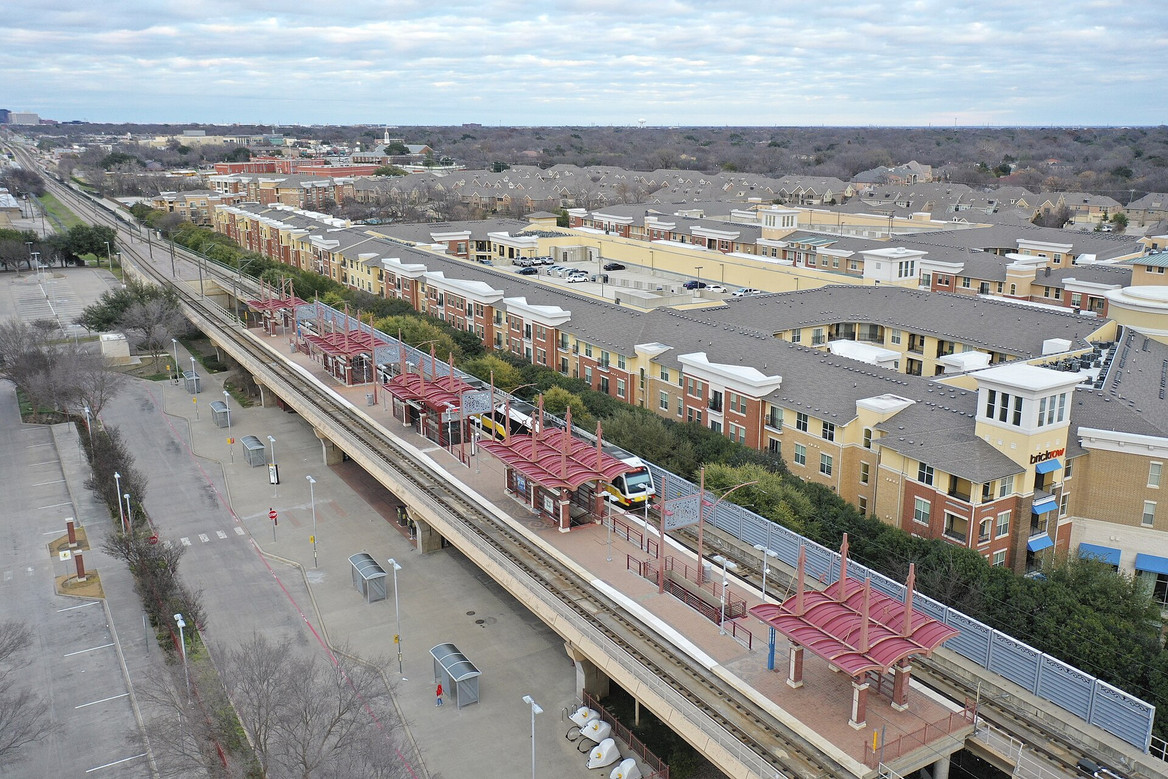
Transit-Oriented Development (TOD) is regarded internationally as a key concept in sustainable urban and regional development. It links settlement development with efficient public transport, both spatially and functionally, aiming for compact, easily accessible neighbourhoods in which people rely less on the car. Studies show that residents of such neighbourhoods make a higher proportion of their journeys by bus and rail.
In German regional and urban development, TOD has established itself as a guiding principle only a little and the body of research remains limited. The Special Issue of the journal Raumforschung und Raumordnung | Spatial Research and Planning (RuR) wants to change this by bringing together empirical findings, theoretical perspectives and planning experience. One question in particular has barely been examined: how can TOD principles be used for the development of existing built-up areas, rather than for new construction on greenfield land? While international research has focused predominantly on growing metropolitan areas, small and medium-sized towns, railway station districts, and suburban and rural areas are increasingly coming into focus. It is precisely these areas that raise questions of their own – about the scope for action under limited growth, about regional cooperation, and about land policy frameworks.
The Call for Papers welcomes contributions relating to TOD in different types of area, on planning and governance across different spatial scales, on finance and land policy, and on affordable housing, gentrification and displacement. Case studies and data- or practice-based analyses at the interfaces between urban, transport, regional and open-space planning are especially encouraged.
Papers may be submitted in German or English in the categories “Forschungsbeitrag / Research Article” and “Kommentar / Commentary” and undergo the standard double-blind peer review process. Abstracts are requested by 30 September 2026 by email to the guest editors; authors will be notified by 31 October 2026, and completed manuscripts are due by 31 January 2027. Print publication is scheduled for autumn 2027. The special issue is edited by Stefan Siedentop (TU Dortmund University), Arvid Krüger (University of Kassel) and Martina Hülz (ARL).
The journal Raumforschung und Raumordnung | Spatial Research and Planning (RuR) is published jointly by the IRS and other spatial-research institutions within the Leibniz R network. Representing the IRS, Manfred Kühn, researcher in the “Politics and Planning” research area, serves as a co-editor of the journal. He is the IRS contact for questions about the call.