
Lost Heritage – Reconstructed Buildings (V.E.R.B.)
Research department: Contemporary History and Archive
Project Leader within IRS: Dr.-Ing. Stefanie Brünenberg Dr. Harald Engler
Consortium: Leibniz Institute for Research on Society and Space (Coordination) Hochschule für Technik, Wirtschaft und Kultur
Funding Organization: Federal Ministry of Research, Technology and Space
Duration: 11/2026 - 10/2029
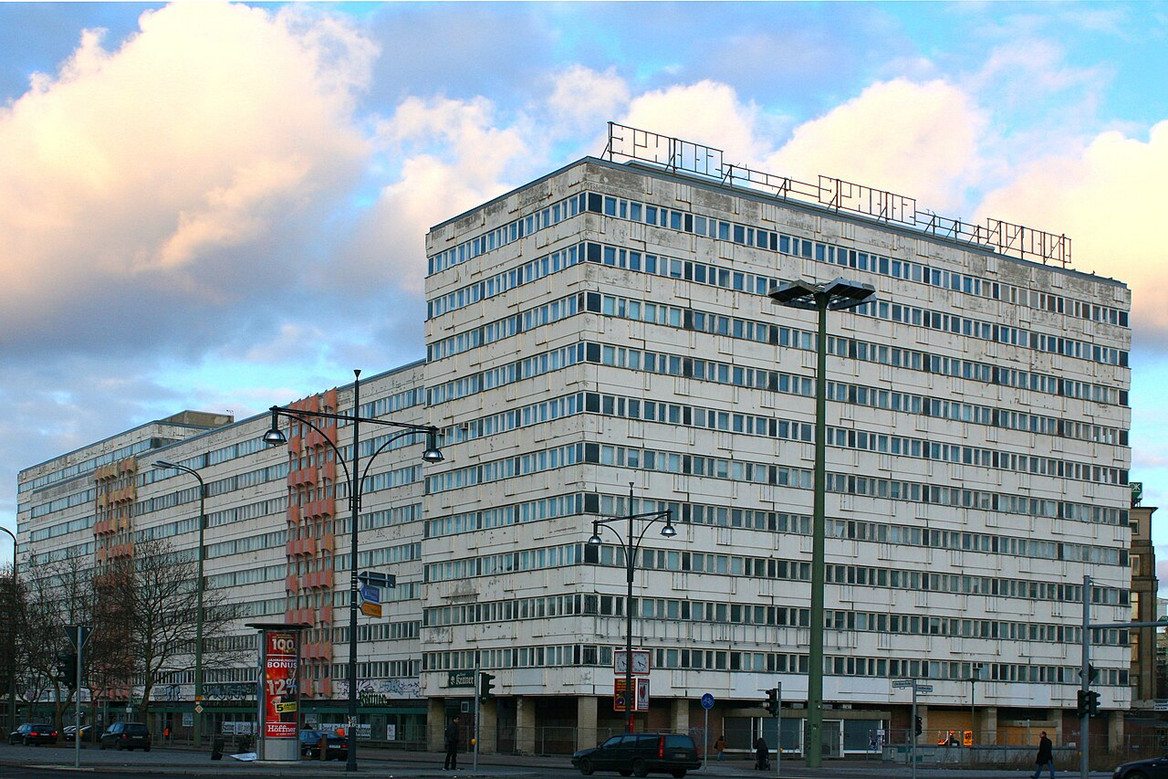
The project aims to analyse the interplay between collective memory, digital transformation and changes to the built environment, using the built heritage of eastern Germany as a case study. The project involves the digital cataloguing, participatory reconstruction and interpretation of the heritage of the second half of the 20th century, with a focus on East German modernism. The project will document buildings and ensembles whose demolition or conversion has had a lasting impact on the urban landscape and collective memory. The sites under consideration include tourist centres (e.g. the Baltic Sea coast), residential areas as examples of everyday history, and "best practice" initiatives such as the Haus der Statistik.
A web-based platform is being developed for historical photographs, eyewitness accounts and memories. It functions as a collective knowledge space, linking everyday history with urban development and addressing ethical questions as well as political instrumentalisation through reflection on practices of remembrance.
Sub-project A (IRS) is responsible for project management. It examines collective memory, identity formation and processes of transformation since 1945, as well as their political instrumentalisation. It is also responsible for methodological foundations, interviews, citizen science surveys, participatory formats (Moving Lab) and documentary work on inventory identification and metadata cataloguing, in close cooperation with Partner B.
Sub-project B (Leipzig University of Applied Sciences, HTWK) complements the social science research with media informatics. The focus is on an AI-supported reconstruction pipeline that combines heterogeneous data sources to create digital 3D models of lost buildings. Technologies compensate for data gaps; members of the public are involved as active validators. HTWK Leipzig provides the technical infrastructure, from data processing through to platform integration. Integration with participatory formats ensures that solutions are socially embedded and can be used responsibly as a scientific research tool.